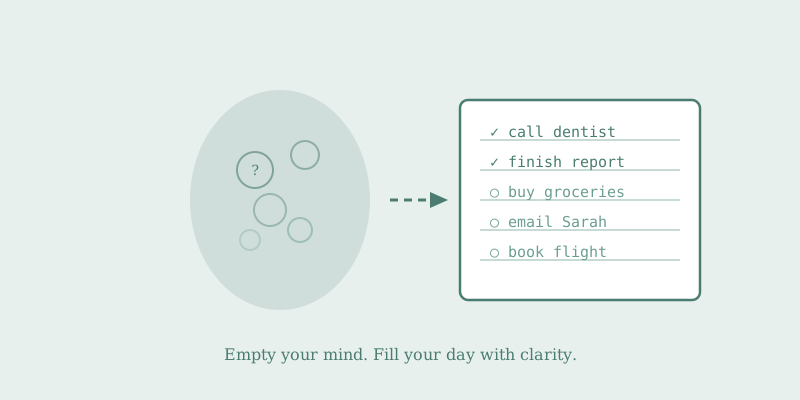
Your brain is not a storage device. It's a processor. And right now, you're trying to use it as both.
That's why you feel overwhelmed. Not because you have too much to do, but because you're trying to remember all of it while also doing it.
A brain dump fixes this. Fast.
What Is a Brain Dump?
A brain dump is exactly what it sounds like. You take every thought, task, worry, idea, and obligation floating around in your head and you write it down. All of it. No organizing, no prioritizing, no filtering. Just empty your mind onto paper (or a screen).
The result is immediate. People report feeling lighter, clearer, and less anxious within minutes. This isn't placebo. There's real cognitive science behind why it works.
The Science: Why Your Brain Loves Being Emptied
Psychologists call this cognitive offloading. It's the practice of using external tools (paper, apps, lists) to reduce the mental load on your working memory.
Your working memory can hold roughly four items at once. Four. Every open tab in your brain, from "buy milk" to "finish the Q2 report" to "call Mom," competes for one of those slots. When you exceed capacity, things start falling through the cracks. You forget. You stress. You feel scattered.
Research published in the Journal of Experimental Psychology found that people who wrote down their upcoming tasks before starting work performed significantly better than those who just kept everything in their head. The act of writing it down freed up cognitive resources for actual thinking.
A separate study from Florida State University found that unfinished tasks create persistent mental tension, sometimes called the Zeigarnik effect. Your brain keeps looping back to incomplete items, draining your attention even when you're not actively working on them. Writing them down signals to your brain that the information is safely stored elsewhere, which reduces that mental nagging.
This is especially powerful for people with ADHD, whose working memory challenges make mental juggling even harder. When you offload everything to paper, you don't have to hold it all at once.
The 5-Step Brain Dump Method
You can do this in five minutes. Here's how.
Step 1: Set a Timer for 5 Minutes
Give yourself a short, bounded window. This prevents overthinking and forces you to dump quickly. Speed matters more than neatness here.
Step 2: Write Everything
Every task. Every worry. Every idea. Every errand. Things you've been putting off. Things you're scared to start. Things you forgot last week. Birthday gifts. Dental appointments. That weird thing you said in a meeting two months ago that still bothers you. All of it.
Don't censor. Don't organize. Don't judge. If it's in your head, it goes on the list.
Step 3: Scan and Categorize
Now look at what you wrote. Group things roughly:
- Do today (urgent, time-sensitive)
- Do this week (important but not burning)
- Do sometime (would be nice, no deadline)
- Let go (things outside your control, worries you can't act on)
This takes two minutes max. Don't overthink the categories.
Step 4: Pick Your Top 3
From the "do today" pile, pick three items. Just three. These are your focus for the day. Everything else can wait.
The paradox of productivity is that doing less usually means accomplishing more. Three completed tasks beat ten half-started ones every time.
Step 5: Schedule Them Into Time Blocks
Assign each of your three tasks to a specific time block. "Work on presentation" is vague. "Work on presentation from 10:00 to 11:30" is a plan. Vague tasks create anxiety. Specific time blocks create action.
If you want to go deeper, add a five-minute brain dump to your morning routine. Do it right after you wake up, before you check your phone. Clear the mental deck before the day fills it back up.
When to Brain Dump
The beauty of this method is that it works anytime you feel overwhelmed. But there are a few moments where it's especially powerful:
Monday morning. Start the week by dumping everything on your mind. You'll see what's actually on your plate instead of carrying a vague sense of dread.
Before a big project. Empty your head of all the loose ends and distractions before diving into deep work. Your focus will be sharper.
When you can't sleep. A nighttime brain dump clears the racing thoughts that keep you awake. Research from Baylor University found that writing a specific to-do list before bed helped people fall asleep nine minutes faster than writing about completed tasks. Nine minutes might not sound like much, but that's a meaningful difference in sleep onset.
When you feel stuck. If you're procrastinating on something and can't figure out why, a brain dump usually reveals the hidden anxieties and unfinished tasks that are creating friction.
Common Mistakes
Turning it into a to-do list too early. The dump phase is for emptying, not organizing. If you start prioritizing while writing, you'll self-censor and miss things. Dump first. Sort after.
Making it pretty. Use whatever is closest. A napkin. The notes app on your phone. A scratchpad. Fancy planners and color-coded systems are fine, but they add friction. The best brain dump is the one you actually do.
Only doing it once. A brain dump works best as a regular practice, not a one-time emergency measure. Your mind fills back up. That's normal. Empty it again.
What This Looks Like in Practice
Imagine you wake up on a Wednesday. Your head is buzzing. You have a client call at 2, a deadline on Friday, your kid needs a costume for school by Thursday, the car is making a weird noise, you haven't exercised in a week, and you keep thinking about that argument with your partner.
You grab a pen. Five minutes later, you have a messy list of 23 things. You scan it. Six are urgent. Three go on today's calendar. The costume goes on tomorrow's list. The car can wait until Saturday. The argument needs a conversation, not a task, so you schedule time tonight.
The rest goes into a "someday" pile. Your mind is clear. You know exactly what matters today. The background hum of anxiety is gone.
That's the brain dump in action. Five minutes of writing buys you a full day of clarity.
The Bottom Line
Your brain is brilliant at processing, terrible at storing. Stop asking it to do both.
Write it down. Clear the decks. Pick three things. Schedule them. Move on.
It takes five minutes. It costs nothing. And it might be the single highest-return productivity habit you ever try.
Stop carrying your to-do list in your head.
Habidu's morning journal and daily planner help you brain dump, prioritize, and time-block your day in minutes.
Try Habidu free →