Most people start their mornings scrambling. Not because the morning was the problem, but because the night before was unfinished. Thoughts left open. A to-do list that never got closed. A day that never got processed.
An evening journal routine changes that. Not because it's magic, but because it does something your brain desperately needs: it helps you close the loop on the day before sleep takes over.
This guide covers exactly what a good evening journal routine looks like, what the science says about why it works, and how to build one that actually sticks.
Why Your Brain Needs a Closing Ritual
Your brain doesn't stop working when you lie down. If anything, it gets louder. Researchers call this "cognitive arousal" before sleep — the mental churn of replaying conversations, drafting tomorrow's plan, or worrying about things left undone.
The Zeigarnik effect is part of what's happening here. Psychologist Bluma Zeigarnik discovered that the brain holds on to incomplete tasks more persistently than completed ones. Your mind keeps pinging those open loops because it's afraid you'll forget them.
Writing things down short-circuits this. When you capture thoughts on paper (or in an app), your brain registers that the loop is closed. It doesn't need to keep reminding you anymore.
A 2018 study published in the Journal of Experimental Psychology found that writing a to-do list for the following day helped participants fall asleep significantly faster. The more specific the list, the better it worked. People who wrote vague summaries got less relief than people who wrote out concrete tasks.
That's the core mechanism. The evening journal isn't a productivity trick. It's a neurological off-switch.
What an Effective Evening Journal Routine Includes
Not all journaling is equal at night. Venting about your day might feel good, but it can also keep you emotionally activated. The best evening journal routine has a clear structure that moves you through three phases: process, close, prepare.
Phase 1: Process the Day (2 minutes)
Before you can let go of the day, you have to acknowledge it. A few simple prompts work better than open-ended reflection:
- What went well today? Even one thing. This primes your brain toward positive closure rather than rumination.
- What felt hard or incomplete? Name it. Writing it down tells your brain you've registered it.
- What surprised me? This question activates pattern recognition and keeps your learning sharp over time.
You're not looking for deep insights here. You're looking for acknowledgment. Two or three sentences per question is enough.
Phase 2: Close the Loop (1 minute)
This is the to-do list portion that the sleep research points to. Write down everything that needs to happen tomorrow. Not a vague "work on the project" but specific actions: "Send the proposal draft to Maria," "Call the dentist before noon."
Getting specific matters because vague intentions stay in working memory. Specific plans feel handled. Your brain can let them go overnight.
If you have things that have been nagging you from today, capture them here too, whether they belong on tomorrow's list or somewhere else. The goal is to empty the buffer.
Phase 3: End on Grounding (1 minute)
This is the part most people skip, and it's arguably the most important.
End your evening journal routine with something that grounds you in the present rather than projecting you into tomorrow. Options:
- One sentence of gratitude (not a list, just one real thing)
- A short affirmation or intention for how you want to feel in the morning
- A note about something you're looking forward to
This phase shifts your nervous system. You're telling your body: the planning is done, it's safe to rest now.
The Science Behind Evening Reflection
The sleep benefits alone justify this habit, but the effects compound well beyond the next morning.
Better sleep quality. The before-bed journaling study mentioned earlier showed participants fell asleep an average of 9 minutes faster when they offloaded to-do items compared to journaling about completed tasks. For people with racing minds, that margin is significant.
Improved self-awareness over time. A study from Harvard Business School found that workers who spent 15 minutes at the end of each day writing about what they learned performed 23% better on subsequent assessments than those who didn't reflect. Reflection speeds up learning from experience.
Reduced anxiety. Expressive writing research dating back to James Pennebaker's work in the 1980s consistently shows that putting stressful thoughts into words reduces their emotional charge. You're not suppressing the thought, you're metabolizing it.
Better next-day focus. When you close out yesterday clearly, you wake up with less cognitive debt. Your morning brain isn't spending cycles processing yesterday's unfinished business. It's ready to engage with today.
Why People Quit (And How Not To)
The most common failure mode is making the routine too long or too elaborate. People read about the ideal journaling practice and design a 30-minute ritual that requires a candle, a specific notebook, and a quiet house. It works for a week, then life happens and it collapses.
The antidote is aggressive simplicity. Five minutes. Three questions. Done.
The second most common failure is inconsistent timing. If you journal "when you have time," you won't. The routine needs an anchor, something you already do every night. After brushing your teeth. After the kids go to bed. Before putting your phone on the charger.
Stack it onto an existing behavior and the decision fatigue disappears.
Third: don't treat missed nights as failures. If you skip a night, the goal isn't to catch up by doing two nights the next day. Just pick it back up. Streaks are motivating, but the pressure of a streak can also make the habit feel high-stakes. Keep it low-stakes and consistent beats perfect.
The 5-Minute Template
If you want something to copy and use tonight:
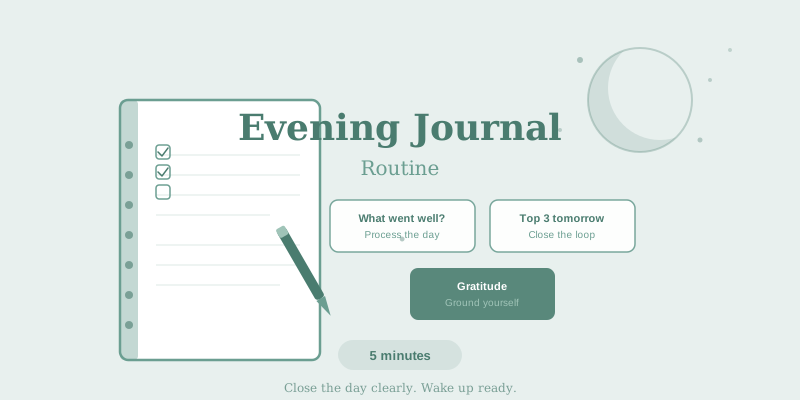
Evening Journal Routine (5 minutes)
1. What went well today? (one thing) 2. What's still on my mind? (one or two things you're carrying) 3. What are my top 3 tasks for tomorrow? (specific actions) 4. One thing I'm grateful for right now: (real, not generic)
That's it. Four prompts. Most nights it takes under five minutes. On harder nights, it might take eight. Either way, you come out of it with a quieter mind.
Building the Habit with Support
The hardest part of any new habit isn't the first night. It's night 12, when the novelty has worn off and you're tired and you think "I'll just do it tomorrow."
This is where external accountability changes the game. Habit-building research consistently shows that people who have some form of follow-up or check-in are dramatically more likely to stick with new behaviors compared to those going it alone.
That might look like a habit app with streak tracking. It might mean a partner who does the routine with you. Or it might be a coaching system that actually follows up when you don't show up, not a passive notification you've learned to ignore but a persistent nudge that doesn't let you off the hook until you've responded.
The evening journal routine is simple enough to do alone. But if your track record with habits is "start strong, fade out," give yourself structural support. The routine is five minutes. The follow-through is where the real work is.
Start Tonight
You don't need a special notebook or a new app or a perfectly quiet evening. You need four questions and five minutes before you close your eyes.
Try it tonight. Write down what went well. Name what's still rattling around in your head. List tomorrow's three specific tasks. Find one real thing to be grateful for.
Your morning self will thank your evening self. Every day that you close out clearly is a day you wake up with momentum instead of mental clutter.
That's the entire promise of an evening journal routine, and it's one of the highest-return five minutes you can spend.
Wind down with intention. Wake up ready.
Habidu's evening reflection feature guides you through a nightly check-in so tomorrow starts clear.
Join the Habidu waitlist →