You've done this a hundred times.
You look at your to-do list and think, "I can knock this out before lunch." Three tasks. Each one seems straightforward. You start at 9 AM, confident you'll be done by noon.
It's 3 PM and you're still on task two.
What happened? You didn't get lazy. You didn't get distracted (well, maybe a little). The real culprit is something psychologists have studied for decades: the planning fallacy. It's the systematic tendency to underestimate how long tasks will take, even when you have experience doing those exact tasks.
And it's not just you. Everyone does this. Engineers, project managers, students, CEOs. The planning fallacy cuts across every profession and skill level.
Here's why it happens, what the research says, and how to actually fix it.
What Is the Planning Fallacy?
The term comes from psychologists Daniel Kahneman and Amos Tversky, who first described it in 1979. They noticed that people consistently make overly optimistic predictions about how long tasks will take, even when they know from past experience that similar tasks took longer.
Kahneman later called it one of the most robust cognitive biases in psychology. It survives feedback, experience, and even direct warnings.
In their original research, Kahneman and Tversky found that people routinely underestimate completion times by 40 to 60 percent. A task you think will take an hour? Plan for 90 minutes to two hours.
The bias shows up everywhere. A classic 1994 study by Buehler, Griffin, and Ross asked students to predict when they'd finish their theses. The average estimate was 33.5 days. The actual average completion time? 55.5 days. Even when researchers asked students for their "best case" and "worst case" scenarios, only 13% finished within their own worst-case window.
The planning fallacy is not about being bad at math or bad at estimating. It's about how your brain constructs predictions in the first place.
Why Your Brain Gets It Wrong
The planning fallacy is driven by a few interconnected cognitive biases:
Optimism bias. You imagine the scenario where everything goes right. The code compiles on the first try. The document doesn't need revisions. Traffic is light. Your brain smooths over potential obstacles because thinking about what could go wrong is unpleasant and cognitively expensive.
Focalism. When you plan a task, you focus narrowly on that task in isolation. You don't account for the context around it: the meetings that will interrupt you, the emails you'll need to answer, the energy dip after lunch. You plan as if you'll be a fully focused, uninterrupted version of yourself.
Failure to recall past accurately. This one is counterintuitive. You'd think past experience would make you better at estimating. But when you remember a previous task, you tend to forget the delays, the false starts, and the complications. You remember the core activity, not the friction around it. So your "experience-based" estimate is still too optimistic.
Inside-view thinking. Kahneman distinguished between the "inside view" (thinking about the specific details of this particular task) and the "outside view" (looking at how long similar tasks typically take, including all the messiness). Most people default to the inside view. They plan the ideal path instead of looking at the historical average.
The ADHD Amplifier
If you have ADHD, the planning fallacy hits even harder. Research by Barkley and others has shown that ADHD involves deficits in executive function, particularly in working memory and time estimation.
People with ADHD experience what's sometimes called "time blindness." It's not that you can't read a clock. It's that your brain struggles to feel how much time has passed or sense how much time a task requires. The future feels abstract. The present feels urgent. So when you plan, you plan from a place of optimism and immediacy, not from a realistic assessment of time.
One study found that adults with ADHD underestimated time intervals by roughly 50% more than neurotypical adults. The planning fallacy is already strong in the general population. ADHD supercharges it.
This is why so many people with ADHD end their days feeling like they failed, even though they worked hard. The plan was unrealistic from the start. The problem wasn't effort. The problem was the estimate.
How to Fix It: Research-Backed Strategies
The planning fallacy can't be cured entirely. It's wired into how your brain makes predictions. But you can reduce its impact significantly with a few practical strategies.
1. Use Reference Class Forecasting
This is the single most effective fix, and it comes directly from Kahneman's later work. Instead of planning from the inside view, ask: "How long did similar tasks actually take me in the past?"
Don't guess. Look it up. Check your time logs, your calendar, your project history. Find the actual data.
If you don't track your time, start. Even a rough log (where you jot down start and end times for tasks) gives you the data you need to build better estimates. After a few weeks, you'll have a personal reference class.
The magic is in the base rate. Your past behavior, averaged across multiple instances, is a better predictor of future behavior than any single plan you make today.
2. Apply the 1.5x Rule
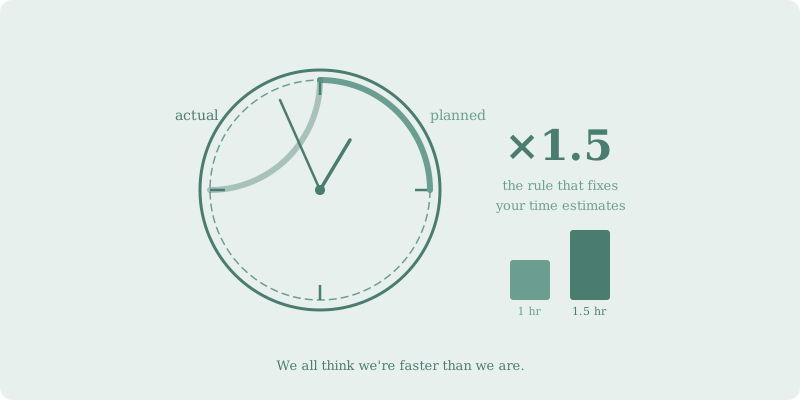
If you don't have historical data, use a simple multiplier. Take your initial estimate and multiply it by 1.5.
This isn't arbitrary. The research consistently shows that people underestimate by 40 to 60 percent. Multiplying by 1.5 gets you into the right ballpark.
A 30-minute task becomes 45 minutes. A two-hour project becomes three hours. This feels wrong at first. It feels like you're padding unnecessarily. But track your actual times for a week and you'll find the 1.5x estimate is usually more accurate than your gut.
3. Plan for the Messy Version
When you imagine doing a task, you picture the clean path. No interruptions. No technical issues. No getting stuck on one paragraph for 20 minutes.
Instead, plan the messy version. Ask yourself:
- What's likely to go wrong?
- What has gone wrong before with this type of task?
- How many times will I get interrupted?
This isn't pessimism. It's realism. The messy version is the version that actually happens.
4. Build Buffer Blocks Into Your Schedule
If you time-block your day, leave 20 to 30 percent of your schedule empty. These buffer blocks catch the overflow from tasks that run long.
Most people pack their schedule tight. When one task runs over, it dominoes into everything else. Buffer blocks stop the cascade.
The specific technique matters less than the principle: schedule less than you think you can do. A schedule with breathing room is a schedule you can actually follow. A packed schedule is a plan you'll abandon by 11 AM.
5. Track and Review Weekly
At the end of each week, compare what you planned against what actually happened. How many tasks ran over? By how much? Where were your estimates closest?
This is the feedback loop that most people skip. Without it, you never calibrate. With it, your estimates improve steadily. After a month of weekly reviews, you'll start catching the planning fallacy in real time, before it derails your day.
Why Most Productivity Advice Misses This
Standard productivity advice says "plan your day" or "time-block your schedule." That's good advice, but it's incomplete. If your time blocks are based on faulty estimates, you're just building a beautiful plan that will collapse.
The fix isn't better planning tools. It's better estimates. And better estimates come from looking at real data instead of trusting your gut.
AI-powered scheduling tools can help here. When an app builds your schedule based on historical patterns rather than your optimistic predictions, the resulting plan is more realistic from the start. It's the difference between the inside view and the outside view, automated.
The Takeaway
The planning fallacy is not a character flaw. It's a cognitive bias built into how every human brain works. Kahneman and Tversky showed that it affects experts and novices alike, even when people are warned about it.
But you can work around it. Use reference class forecasting. Apply the 1.5x multiplier. Plan for the messy version. Build in buffer time. Review your estimates weekly.
Start with one of these this week. Track your estimates and actuals for seven days. The gap between the two will tell you everything you need to know about your personal planning fallacy, and it will probably be the most productive experiment you run all month.
Stop Planning for the Best Case
Habidu helps you build realistic daily schedules with AI-powered time blocking that learns from your actual patterns, not your optimistic predictions.
Join the Habidu waitlist →